Solid Light: When Massless Photons Bind and Carry Weight
We did not conquer the dark. We gave it mass.
Light has no rest mass. It carries no weight you can feel, raises no walls, and offers no shelter. For centuries that read as an absolute law. Then physicists learned to make photons touch each other, bind together, and drag like heavy particles through a medium. The jump from a quantum optics textbook to something you could almost lean against did not begin in a clean laboratory. It began with one stubborn question: if light weighs nothing, how can it ever push back?
Table of Contents
- If Photons Have No Mass, How Can Light Push Anything?
- What Is a Photonic Molecule?
- How Did Three Photons Become a New Form of Light?
- Can Light Be Slowed Down Enough to Touch?
- Where Is Solid Light Already Working Today?
- The Canvas of Controlled Decay
- The Weight of the Illusion
- FAQ
If Photons Have No Mass, How Can Light Push Anything?
Light weighs nothing, yet it shoves matter. Sunlight peels comet tails away from the sun. A focused laser drags a single living cell across a microscope slide. The shove is momentum, and it is real.
A photon weighs nothing at rest, but it carries momentum equal to its energy divided by the speed of light. Every time light strikes a surface and bounces away, that momentum transfers as a real, measurable shove. Physicists call it radiation pressure, and it stopped being theory a long time ago. It is engineering.
The cleanest proof lives in a microscope. In 2018 the Nobel Prize in Physics went half to Arthur Ashkin for the optical tweezer, a focused laser beam that traps and drags living cells using nothing but light, exerting forces on the order of piconewtons 1. Light reaches into matter and grips it.
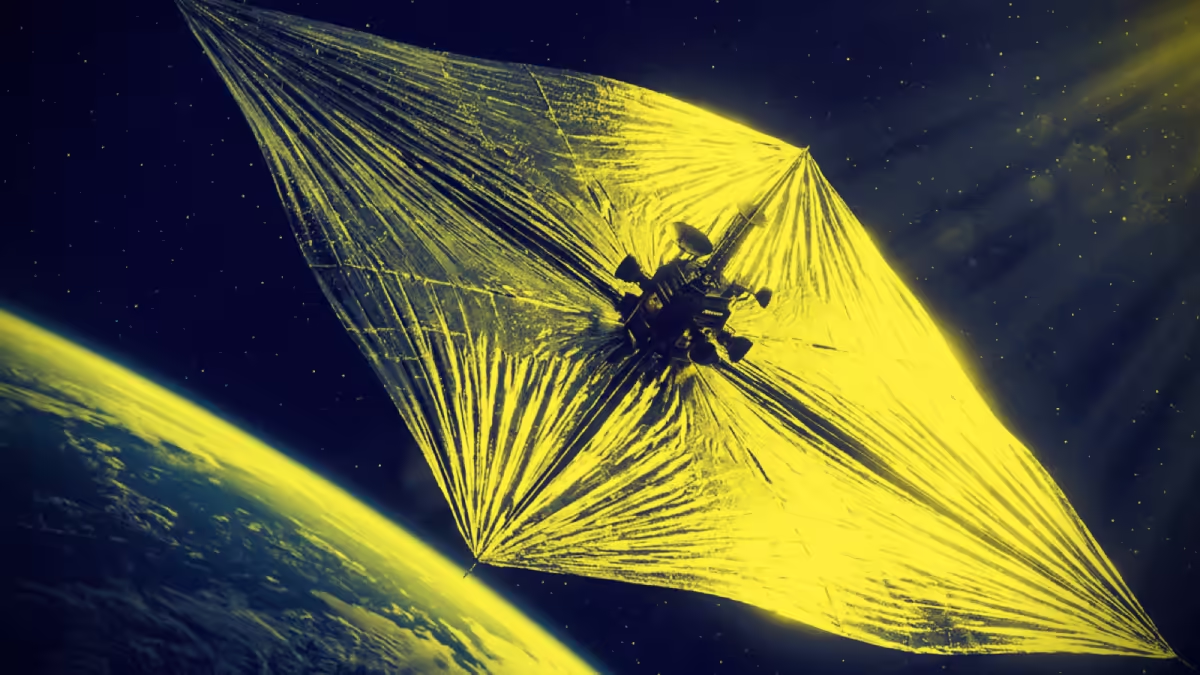
It also sails ships. The Planetary Society launched LightSail-2 in 2019, and over the following weeks the spacecraft raised its orbit by roughly two kilometers using only the pressure of sunlight striking a 32-square-meter mylar sail 2. Massless photons pushed a spacecraft into a higher orbit.
Light carries force. The open question is whether that force can hold shape, bind with itself, stack into something you can lean against.
What Is a Photonic Molecule?
Two flashlight beams crossed in a dark room pass straight through each other like ghosts. Photons do not interact. Forcing them to took a specific kind of matter: atoms cooled to almost absolute zero.
In 2013 a group led by Ofer Firstenberg and Mikhail Lukin fired weak laser pulses into a cloud of rubidium-87 atoms cooled to a fraction of a degree above absolute zero. Inside that frozen vapor, each photon coupled to a highly excited Rydberg atom to form a hybrid object called a Rydberg polariton 3.
The mechanism is the Rydberg blockade. Excite one atom and it blocks any neighbor within a certain radius from also exciting, like a chair that, once taken, ropes off the seats around it. Two photons entering that zone cannot each claim their own atom. They share a single excitation between them. They feel each other. They emerge from the cloud traveling together, phase-locked, pushing and pulling as a bound pair.
For the first time, light had effective mass and friction. Two photons that should have ignored each other instead formed a molecule. They still traveled at the speed of light through the medium, but they did it as one object. The abstract phrase "interacting photons" became a thing you could measure on an oscilloscope.

Did you know? The binding is so fragile that it collapses the instant the rubidium warms toward room temperature. Every photonic molecule ever made has existed inside a near-absolute-zero vacuum chamber, for fractions of a second 3.
How Did Three Photons Become a New Form of Light?
Two bound photons could, in principle, be a fluke of timing, two travelers who happened to walk in step. Three is where coincidence stops being a plausible explanation.
Five years after the 2013 result, researchers at MIT sent photons through a similar Rydberg medium and watched for triplets. What came out was a bound state of three photons traveling as a single object, with a measurable phase shift that confirmed they were not merely traveling in parallel 4.
Three bodies locked in a stable, correlated state is the signature of genuine interaction, the kind of collective behavior we associate with molecules and matter, not with light. The group described the result as a new form of light, and the label is earned.
Photons can be coaxed into structures that persist, with internal relationships, acting less like a beam than a piece of material. Given the right medium, light holds together.
Can Light Be Slowed Down Enough to Touch?
Binding photons is only half the problem. To feel solid, light must also be slow and dense, dense enough that trillions of bound photons stack into a surface your hand meets with resistance. And a photon always moves at c, so how is slow light possible? The drag comes from the medium. Inside a dense material each photon is absorbed and re-emitted by atoms over and over, and that stop-and-go makes the pulse crawl, even though the photon itself still travels at c between handoffs.
In 1999, Lene Hau and her team at Harvard passed a pulse of light through a Bose-Einstein condensate of sodium atoms and slowed it to roughly 17 metres per second, slower than a car on an open road 5. Two years later the same group stopped light entirely, mapping the photon pulse into the atomic medium and retrieving it intact. Light had been parked.

Every one of these effects demands a medium kept a hair above absolute zero, in vacuum, at picowatt energies. The binding collapses the instant the rubidium warms to room temperature. A wall of hard light you can lean against is not on any laboratory bench. What the experiments prove is the principle: photons can be made to interact, to bind, and to drag. What does not yet exist is the scale, and the medium.
Where Is Solid Light Already Working Today?
In 2022, the company Xanadu reported a programmable photonic quantum processor called Borealis that ran Gaussian boson sampling faster than the best classical supercomputers, the first cloud-accessible machine of its kind 6. Solid light, in the strict scientific sense, is already a working technology. It just does its work inside chips and cryostats, not inside architecture.
The clearest applications cluster around quantum information. Because interacting photons make natural, low-noise qubits, the same Rydberg binding that produced photonic molecules now drives neutral-atom quantum computers that use the blockade effect to perform two-qubit gates. Atom Computing reported a 1,180-qubit neutral-atom machine in 2024, and rival systems from QuEra and Pasqal ship commercially. The science that bound two photons in 2013 is, a dozen years later, a product category, and like every frontier in compute it carries an appetite for power and water that degrades the substrate beneath it.
A second thread is memory. Slow light underpins the Duan-Lukin-Cirac-Zoller protocol for quantum repeaters, the devices a long-distance quantum internet needs to store and re-emit photonic qubits without ever measuring them. Parking a light pulse in an atomic ensemble and retrieving it intact, exactly as Hau did, is the same physics that could one day route entangled photons across continents.
A third thread is mechanical. Optical tweezers, Arthur Ashkin's 2018 Nobel work, are now standard kit in biology labs, used to stretch DNA strands and hold single cells steady for study 1. Light reaches into matter and manipulates it, every working day, on microscopes around the world.
Every one of these real applications keeps the binding locked inside a controlled medium: a silicon chip, a cold atom trap, a microscope focal point. The binding works. The medium stays small.
IMPORTANT
- Photons carry no rest mass but they do carry momentum, which is why the Planetary Society's LightSail-2 raised its orbit on sunlight alone in 2019.
- In 2013, Ofer Firstenberg and Mikhail Lukin bound two photons into a single photonic molecule inside ultracold rubidium 3.
- In 2018, an MIT team extended that to three photons, a documented new form of light 4.
- Lene Hau slowed light to roughly 17 metres per second in 1999, proving photons can behave as if they carry weight 5.
- Solid light is already commercial: Xanadu's photonic processor Borealis beat classical supercomputers at boson sampling in 2022 6.
The Canvas of Controlled Decay
Everything above this line is measured and published. Everything below it is not. This is where the physics leaves the laboratory and crosses into Techno Apocalypse — the universe of Code Red, and its capital, Neo Babylon, a city that took the binding you just read about and poured it into the open air.
The leap from laboratory to city is a jump of one variable, not of principle. The same physics, scaled to a different medium:
| In the laboratory, today | In Neo Babylon, in the novel |
|---|---|
| Photonic qubits bound in a cryostat (Borealis; Firstenberg 2013) | Hard-light walls filling real space, traversable by the body |
| Slow-light quantum memory, light parked in atoms (Hau; DLCZ) | AetherNet pulses stored and recalled inside the haze |
| Optical tweezers gripping single cells | Hard-light objects whose texture is felt through the connection |
| Rydberg blockade in ultracold rubidium vapor | Metallic aerosol as a city-scale binding medium |
The engineers stopped shrinking the medium. They scaled it. They turned the air itself into the cloud chamber.
Ecologists call it atmospheric collapse. Urban planners call it a necessary byproduct of hyper-industrialization. In the story the truth is more deliberate. The dense, smoky haze choking the lower levels of Neo Babylon is an engineered medium, not an accident.
This is controlled pollution. The air is saturated with specific concentrations of metallic particulate: microscopic aerosols of barium, strontium, and synthetic rare-earth metals. These particles are not stray emissions drifting out of factory stacks. Atmospheric drones seed them into the sky to maintain a permanent, city-wide refractive medium.
The logic tracks the laboratory work, then discards its weakest constraint. Photonic molecules need a dense, slow-light medium to survive, and ultracold rubidium dies the moment it touches open air. So the engineers replaced the medium. They traded a vacuum chamber for a sky thick with metallic aerosol that holds the refractive index the binding requires.
Did you know? The metallic particulate in Neo Babylon's air is magnetically polarized. Security drones use localized electromagnetic fields to thicken or thin the haze in real time, altering the optical density of the air to blind surveillance or trap fleeing suspects.
Introduce high-intensity, multi-axis laser arrays into that saturated air and the purpose of the heavy haze snaps into focus. The metallic particles act as a distributed array of lenses on a city scale. Light refracts, slows, and undergoes photonic binding at a macroscopic register. The result is the AetherNet bleeding out of screens and into the open air, light structured into the room itself.
These are not flat projections. They are digital rooms of hard light, volumetric structures that occupy the same streets you walk, coexistent with reality but not solid. Your body passes straight through them. Connect to the AetherNet and the feed does the rest: the wall your hand meets, the texture of a chair that exists only as bound light. The AetherVerse overlaps with reality visually and tactilely, but that touch arrives through the connection, not through the air. For the deeper map of who wields it, see our breakdown of the powers shaping the Transhuman Dream universe, where Babel Solutions projects interactive, three-dimensional cerebral advertising directly into your living space, while AndrusDynamics sells private hard-light architectural overlays to the ultra-rich. If the cyberpunk lineage is new to you, the roots of the Transhuman Dream universe is the place to start.
The boundary between the physical city and the digital network dissolves. The environment becomes programmable.
The Weight of the Illusion
Living inside a refracted illusion exacts a neurological toll. The human brain evolved to trust its tactile feedback. Through the connection, a wall of hard light feels solid, dense, unyielding. In the room, your body walks straight through it. Two realities on the same street, in the same moment, and the brain has to hold both.
This sensory dissonance forces the brain to constantly reconcile conflicting data. Over time, the continuous processing of tactile illusions degrades the neural pathways responsible for spatial awareness and reality testing. The cost is not poetic. It is mechanical. For the longer view of what happens when the interface sinks into the nervous system, read our piece on brain-computer interfaces and the limits of the human lifespan.
This is a primary catalyst for Meltdown. The breakdown begins as a subtle detachment, a feeling that the physical world is hollow. As the brain struggles to separate refracted light from actual matter, the symptoms escalate from total apathy to extreme, violent euphoria. The mind rejects the environment, and the body follows.
We built a city where the walls are made of light and the air is made of metal. The technology is flawless. What happens to a mind that can no longer trust its own hands?
FAQ
Do photons actually have mass?
No rest mass. A photon cannot be weighed on a scale. But it carries momentum equal to its energy divided by the speed of light, which is why light pushes things. The 2018 Nobel Prize for optical tweezers and the 2019 LightSail-2 mission both rest on that momentum 1 2.
Can light really exert a physical force?
Yes, and routinely. Optical tweezers use focused laser beams to trap and move individual cells with piconewton-scale forces, work that won Arthur Ashkin half of the 2018 Nobel Prize in Physics 1. LightSail-2 raised its orbit by roughly two kilometers using only sunlight striking a reflective sail 2.
Has anyone actually bound photons together?
Yes. Firstenberg and Lukin's 2013 experiment bound two photons into a photonic molecule inside ultracold rubidium 3, and an MIT team extended it to three photons in 2018 4. Both are peer-reviewed.
Is solid, touchable light possible today?
Not at any useful scale. Photon binding and slow light are real and demonstrated, but only inside ultracold vacuum chambers at near-absolute-zero temperatures. A wall of hard light dense and warm enough to touch is not yet built. The physics exists; the medium does not.
If you want to decode the architecture of Neo Babylon and track the bleeding edge of transhuman tech, subscribe to the newsletter. Join the resistance on Discord.
The air is heavy tonight. Breathe it in.
References
The Nobel Prize in Physics 2018, popular information (Arthur Ashkin, optical tweezers), https://www.nobelprize.org/prizes/physics/2018/summary/ ↩ ↩2 ↩3 ↩4
The Planetary Society, LightSail program (solar-sail orbital demonstration, 2019), https://www.planetary.org/sci-tech/lightsail ↩ ↩2 ↩3
Firstenberg, O., Peyronel, T., et al. "Attractive photons in a quantum nonlinear medium," Nature 502, 71-75 (2013), https://www.nature.com/articles/nature12512 ↩ ↩2 ↩3 ↩4
MIT News, "Physicists create new form of light" (three-photon bound states, 2018), https://news.mit.edu/2018/physicists-create-new-form-light-0215 ↩ ↩2 ↩3
Hau, L. V., et al. "Light speed reduction to 17 metres per second in an ultracold atomic gas," Nature 397, 594-598 (1999), https://www.nature.com/articles/17561 ↩ ↩2
Madsen, L. S., et al. "Quantum computational advantage with a programmable photonic processor" (Xanadu Borealis), Nature 606, 75-81 (2022), https://www.nature.com/articles/s41586-022-04725-x ↩ ↩2
- Authors

- Name
- Felix Novidad
- Published on
- 14 min read