CERN Shut Down the LHC: Dark Matter, or Something Else?
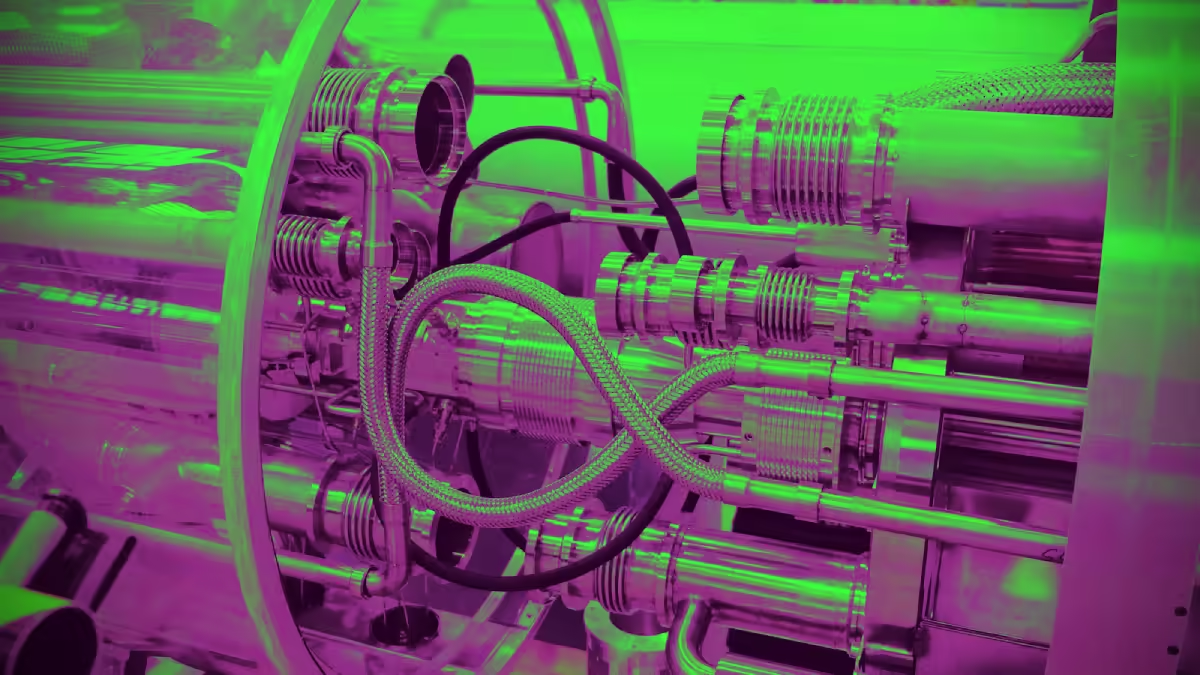
The machine went quiet. The questions got louder.
Beneath the Franco-Swiss border, the largest machine humanity has ever built has fallen silent. The Large Hadron Collider (LHC) — a 27-kilometre ring of superconducting magnets buried roughly 100 metres underground — is in the middle of Long Shutdown 3 (LS3), a multi-year pause to upgrade the accelerator for its high-luminosity future 1. No protons are colliding. No data is streaming. The detectors are cold and open, gutted for maintenance like a cathedral during renovation.
The silence is routine to physicists. To everyone else, it has a different sound. Because the LHC was never just an instrument. It was a hole punched through the wall between what we know exists and what we suspect does. And a persistent corner of the internet believes that, sometime during those collisions, the wall punched back.
Table of Contents
- What was the LHC built to find?
- Geneva, again
- The symptom we misnamed "memory"
- Is dark matter actually a substance?
- The first symptom
- FAQ
What was the LHC built to find?
Strip away the mythology and the LHC has a clean, stated purpose: smash protons together at nearly the speed of light and study the debris. Out of that debris, in July 2012, two independent experiments — ATLAS and CMS — confirmed the existence of the Higgs boson, the particle that gives other particles their mass 2. The finding completed the Standard Model of particle physics and earned the 2013 Nobel Prize for the theorists who predicted it half a century earlier 3.
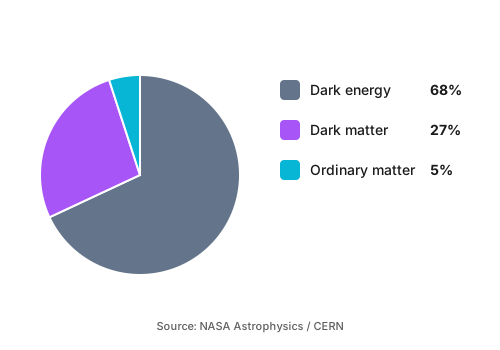
But confirmation is not closure. The Standard Model describes only about 5% of the universe. The rest — roughly 27% dark matter and 68% dark energy — is invisible, undetectable by light, and mathematically necessary to explain why galaxies hold together at all 4. Galaxy rotation curves, gravitational lensing, the cosmic microwave background, the Bullet Cluster: decades of evidence insist something massive is out there, exerting gravity, refusing to interact with anything we can see 5.
Did you know? The LHC does not "see" dark matter directly. It hunts for it as missing energy — collisions where the books don't balance, where something has carried momentum away through the detector without leaving a trace 4. The strategy is to catch dark matter by the shadow it casts.
So far, that shadow has not appeared. Whatever dark matter is, it has not shown itself in the collisions. The machine designed to corner it has, instead, gone to sleep.
Geneva, again
Here is where the science stops and the coincidence begins.
The LHC sits outside Geneva — the same city that, in the world of Techno Apocalypse, housed the operational headquarters of ExoCo, the corporation that drove the implementation of Omega-generation artificial intelligence, sparked the corporate AI war, and ended in bankruptcy.
This is not a claim. It is a location. But the symmetry is worth sitting with: the city tied, in our fiction, to the corporation that started a war between humans and their machines is the real-world city where humanity built its most aggressive probe into the fabric of reality. One is story. One is steel and superconductors. Both share a postcode.
Did you know? In the Techno Apocalypse timeline, the final corporate war (CW4, 2047–2050) — the open war between artificial intelligences and the corporations that created them — was fought almost entirely on the Net front: not on battlefields, but inside the network itself. The decisive blows landed in infrastructure the public could not see.
Draw the line between those two facts however you like. The article is not here to draw it for you.
The symptom we misnamed "memory"
If a machine ever did pierce the membrane between this reality and another one, the first sign would not be an explosion. It would be small. Quiet. A faint wrongness in the texture of the everyday.
That wrongness already has a name. In 2009, a researcher named Fiona Broome coined the term "Mandela Effect" after discovering she — and thousands of strangers — shared a vivid, specific memory of Nelson Mandela dying in prison in the 1980s 6. He did not. He was released in 1990, became South Africa's president, and died in 2013. The memory was false. The consensus behind it was not.
The catalogue has only grown: Berenstain Bears remembered as Berenstein, a monocle on the Monopoly man that never existed, a film Shazaam starring the actor Sinbad that was never filmed. Tens of thousands of people, independently, recall details that the physical record does not contain 6.
Mainstream psychology has an explanation. Human memory is reconstructive, not recording — it edits, fills gaps, and converges on shared errors through social reinforcement and the suggestibility of crowds 7. Under that reading, the Mandela Effect is a glitch in the witness, not a glitch in the world.
And then there is the other reading — the one that circulates in the forums, the one that names the LHC as the culprit. It claims the collisions did not just shatter protons. They shattered the continuity of reality itself, and the Mandela Effect is the first visible scar: collective proof that the past we remember is no longer the past that happened.
There is no scientific support for that claim. No peer-reviewed paper ties a particle accelerator to a false memory. By the standards of evidence that built the Standard Model, the theory does not hold 4. It is a hypothesis, and a fringe one, and it should be flagged as such.
But notice what it refuses to explain away. The theory survives not because the evidence is strong, but because the experience is. People are not wrong that something feels off. They disagree only about the cause.
Is dark matter actually a substance?
The deeper question is not whether the LHC broke something. It is why we assume reality has only one layer at all.
Dark matter, despite the name, may not be a "substance" in the sense we mean. It is whatever accounts for the missing mass of the universe — and our only language for it is negative. It is not light. It is not ordinary matter. It does not collide, does not emit, does not absorb. It is defined entirely by what it refuses to do, even as its gravity holds every galaxy in place 4 5.
Reframe it. If a force existed that overlapped the physical world without interacting with it — pressing into our reality from a layer we cannot measure — it would look exactly like this. Not a thing. A pressure. The rest of the universe, leaning against the glass.
This is the architecture of an AetherVerse — in Techno Apocalypse, a virtual world embedded within the AetherNet, a radio signal that envelops Neo Babylon and lets its citizens inhabit virtual spaces that overlap the physical city. Not a second world hidden behind this one. A second world laid over it, present at once, always on.
The LHC was built to test one seam: the one between known physics and the missing 95% of the universe. It found the Higgs on the near side. On the far side, it found nothing — or nothing it could measure. A shutdown, in that light, is not an ending. It is a held breath.
The first symptom
Maybe the LHC caused nothing. Probably it did not. The science says memory is unreliable, dark matter is silent, and the machine is offline for a scheduled upgrade 1 4 7. All of that is true, and well-sourced, and it should hold more weight than a forum thread.
And still — when millions of people remember a past the world insists never happened, the cleanest explanation can feel like the least honest one. The question is not whether they are wrong. The question is what they are reacting to, and whether anyone is actually listening.
Fiction has already given that feeling a shape. The AetherNet lies over the physical city — a virtual layer that overlaps it, present at once, hard to tell apart. Two realities, occupying the same streets. The only thing harder than telling them apart is trusting which one you remember.
The signal is not a place people visit and leave. It is the city, extended. Citizens stop telling the real from the virtual, because the virtual is only the real reaching further, and both now carry the same weight, the same certainty.
In Neo Babylon, the corporations slip into your mind without you even noticing — a system balanced between coded efficiency and programmed decay. Memory is the first thing it runs on. Whether you can trust yours is the question the city never answers.
What do you remember that the record doesn't?
FAQ
Why is the LHC shut down right now?
The LHC is in Long Shutdown 3 (LS3), a scheduled multi-year pause to upgrade the accelerator for the High-Luminosity LHC programme. No collisions are running; the detectors are open for maintenance. It is a planned upgrade, not a closure 1.
Did the LHC cause the Mandela Effect?
No scientific evidence supports that claim. No peer-reviewed paper links a particle accelerator to collective false memory. The Mandela Effect is explained by mainstream psychology as reconstructive memory shaped by social reinforcement and suggestion 7. The accelerator theory is a fringe hypothesis and should be treated as such.
What is dark matter, and has the LHC found it?
Dark matter is the name for whatever accounts for roughly 27% of the universe's mass that is invisible, does not emit or absorb light, and is detected only through its gravity 4 5. The LHC hunts for it indirectly as missing energy in collisions. As of LS3, it has not appeared in the data 4.
What is the Mandela Effect?
A term coined in 2009 by researcher Fiona Broome for the phenomenon where large, unrelated groups of people share a vivid, specific memory of an event that the physical record shows never happened — most famously Nelson Mandela's death in prison in the 1980s 6.
If the record and your memory disagree, you'll want to be on the inside of the signal. Join the newsletter for the first chapter of Code Red before public release, or step into the city on Discord.
References
CERN, "CERN bids farewell to the LHC and enters Long Shutdown 3" (Long Shutdown 3 upgrade programme for High-Luminosity LHC), https://home.cern/cern-bids-farewell-to-the-lhc-and-enters-long-shutdown-3/ ↩ ↩2 ↩3
CERN, "The Higgs boson, ten years after its discovery" (official announcement and peer review, 4 July 2012), https://home.cern/cern-experiments-observe-particle-consistent-with-long-sought-higgs-boson/ ↩
The Nobel Assembly at the Royal Swedish Academy of Sciences, The Nobel Prize in Physics 2013 (F. Englert and P. W. Higgs), https://www.nobelprize.org/prizes/physics/2013/summary ↩
CERN, "Dark matter" (science overview; LHC search via missing transverse energy), https://home.cern/science/physics/dark-matter ↩ ↩2 ↩3 ↩4 ↩5 ↩6 ↩7
NASA, "NASA Astrophysics" (overview on dark matter, dark energy and universe expansion; galaxy rotation curves, gravitational lensing), https://science.nasa.gov/astrophysics/ ↩ ↩2 ↩3
Fiona Broome, The Mandela Effect (term coined 2009; documentation of shared false memories), https://www.verywellmind.com/what-is-the-mandela-effect-4589394 ↩ ↩2 ↩3
Elizabeth Loftus, "Planting misinformation in the human mind: A 30-year investigation of the malleability of memory" (memory as reconstructive process; social contagion and suggestibility in collective false recall), Learning & Memory, Vol. 12, 2005, pp. 361–366, https://www.apa.org/news/podcasts/speaking-of-psychology/memory-manipulated ↩ ↩2 ↩3
- Authors

- Name
- Felix Novidad
- Published on
- 10 min read