Chat Control 2: Big Brother Came Back on a Quiet Thursday
The vote happened the day before summer recess. Most of the room was empty.
On a Thursday in July 2026, the European Parliament revived a law that lets the biggest technology companies scan private messages for child sexual abuse material. The cause is unimpeachable. The mechanism is not.
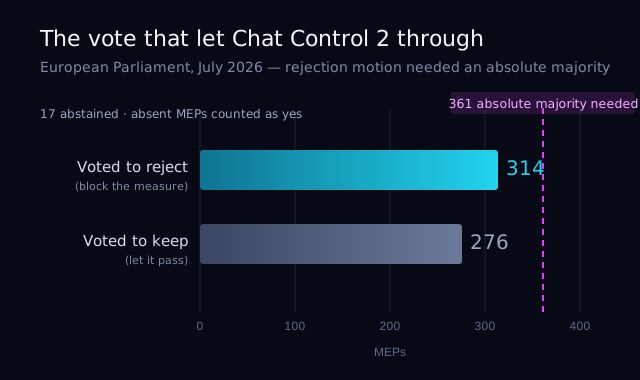
A motion to reject the measure drew 314 votes — a clear majority of the lawmakers actually sitting in the chamber. Only 276 voted to keep it. Seventeen abstained. To kill it outright, though, the chamber needed an absolute majority: 361. The motion fell short by 47 votes 1 2. Under the rule governing that ballot, every absent member was counted as a yes. The measure passed while most of the people who would have stopped it were already heading to the airport.
It has a name now. Chat Control 2. And while the chamber emptied, the cars filled with cameras.
Table of Contents
- What is Chat Control 2?
- Why do 500 cryptographers call it a danger to democracy?
- Why is there a camera in your dashboard?
- 1984 was a warning, not a manual
- The version Neo Babylon already runs
- FAQ
What is Chat Control 2?
Chat Control is the shorthand for a push to make technology companies scan private, end-to-end-encrypted messages for child sexual abuse material — known as CSAM — before the content reaches the person it was sent to. The July 2026 vote renewed the temporary, voluntary version. Chat Control 2 is the larger ambition: a permanent mandate to scan encrypted messaging itself 1 2.
End-to-end encryption is the reason a message you send can be read by you and the recipient and nobody in between — not the server, not the company, not a court order served on the company. Breaking that requires client-side scanning: the software reads your message on your own phone, before it is encrypted, and compares it against a database of known hashes. The maths that protects the message is opened, on the device you carry, by a process you cannot inspect.
Did you know? A hash is a digital fingerprint — a short string derived from a file. Two different images can, very rarely, produce the same hash, the same way two strangers can share one. At the scale of hundreds of millions of messages, "very rarely" stops being rare.
The cause matters. Protecting children from exploitation is among the few aims that almost nobody argues against. The argument is not about the aim. It is about whether this tool can achieve it without dismantling the thing it touches. It is about how a measure this consequential gets decided. It was decided on a Thursday, the day before recess, by a vote where not showing up meant yes.
Why do 500 cryptographers call it a danger to democracy?
In September, an open letter signed by more than 500 cryptographers, security researchers, and scientists from 34 countries delivered a verdict the European Commission has never refuted on the merits: the proposal is "technically infeasible," it is "a danger to democracy," and it would "completely undermine" the security and privacy of every citizen in Europe 3 4.
Sources: The Record (Recorded Future News); GDPR Register, 2026.
Their point is not ideological. It is arithmetic. The detectors do not exist. The research record shows that even the most advanced systems would produce unacceptably high rates of false positives and false negatives, making them unfit for a detection campaign covering hundreds of millions of users 3. Translate that into lives. The scientists name who gets caught: families sharing holiday photographs, teenagers in consensual relationships, doctors exchanging clinical images. All flagged, all under automatic suspicion, because the machine cannot tell a crime from a beach 4.
Did you know? The same letter warns the scanning infrastructure would create new vulnerabilities — backdoors into private communications that hackers and hostile states could exploit. The tool sold as a shield would, by design, install a door.
When the people who actually build the locks tell you a lock cannot be built, the conversation is no longer about policy. It is about whether anyone is listening.
Why is there a camera in your dashboard?
While the Parliament debated your messages, your car was being fitted with a lens. Under the EU's Advanced Driver Distraction Warning rules — ADDW — every new car sold in the bloc now carries a camera pointed at the driver's face 5 6.
The stated purpose is safety: the system watches for distraction and drowsiness and warns the driver. The regulation specifies a closed loop: the systems are not meant to record or retain data beyond what the warning requires. An explanatory memo clarifies the ban covers identifying the person, not the use of the camera data itself 6. In other words: the footage can be processed. It simply is not supposed to be stored, or tied to your name.
The gap between "supposed to" and "can" is where every surveillance system actually lives. In 2023, Reuters reported that former employees at a major carmaker had privately shared sensitive recordings pulled from customer vehicles' cameras between 2019 and 2022 — crashes included 5. That case did not involve ADDW. It involved the same species of hardware: a camera, in a car, pointed at the people inside, run by a company that promised the footage was private.
Did you know? Once every new car carries the physical hardware to monitor a driver through an infrared camera, a single software change and a storage device would be enough to start recording behaviour — a point made by industry analysts watching the rule roll out 6. The regulation forbids identification. The hardware does not care what the regulation forbids.
The dashboard camera is not Chat Control. It is the same logic in a different chassis: a lens, normalized into daily life, pointed at you, governed by a rule that trusts the operator.
1984 was a warning, not a manual
In 1949, George Orwell published Nineteen Eighty-Four. Its central instrument is the telescreen — a device in every home that cannot be dimmed, cannot be turned off, watches and listens simultaneously, and is watched back by a state that decides what its citizens may say, think, and remember. Big Brother is not a person. Big Brother is a condition: the complete absence of a space that belongs to you.
Orwell wrote the book in the shadow of totalitarian radio and cinema. He imagined the surveillance as a wall-mounted screen. He got the medium wrong. He got the principle exactly right. The telescreen's defining feature was never the screen. It was the two-way channel — the idea that the same device you trusted to bring you the world was also reporting on you, continuously, and that you would never be sure when it was listening.
Put a scanning process inside your phone that reads your messages before they are encrypted. Put a camera in your dashboard that watches your face. Hand the keys to companies whose business model is the data they collect, under regulations written to forbid the storage of data rather than the hardware that produces it. The medium has changed. The condition has not. Orwell's nightmare was never the camera. It was the normalization — the slow, quiet process by which a society agrees to be watched, because each new lens arrives attached to a cause no reasonable person would oppose.
Safety on the roads. Protection of children. Each, on its own, unimpeachable. Stacked together, across a phone and a dashboard, they describe a shape Orwell drew in 1949.
The version Neo Babylon already runs
None of this is speculative. The fiction has already drawn it.
In Techno Apocalypse, the corporations slip into your mind without you even noticing — a system balanced between coded efficiency and programmed decay. The mechanism is blunt: authorities, and any corporation that chooses to, can extract information straight from a citizen's neural link. Not a phone, not a dashboard lens. The brain.
A scan that reads your messages is the message layer. A camera in the dash is the physical layer. The neural link is the layer after that, the one that sits behind your eyes. Each arrives attached to a cause no reasonable person argues against, and each one makes the next easier to accept.
Nobody casts a vote for Big Brother. They cast a vote for safety, for children, for the road, on the day before recess, when the room is empty, and they discover what they built only once it is running.
The rot was never hidden. It was scheduled.
IMPORTANT
- Chat Control 2 cleared the European Parliament after a rejection motion drew 314 votes against the 361 needed; under the absolute-majority rule, absent MEPs were counted in favour (The Record, 2026; GDPR Register, 2026).
- Over 500 cryptographers and security researchers from 34 countries signed an open letter calling the scanning mandate "technically infeasible" and "a danger to democracy" (Computer Weekly; Patrick Breyer).
- Every new car sold in the EU now carries an ADDW camera pointed at the driver's face — a regulation that forbids identifying the person, not using the footage (Reason, 2026).
FAQ
What is Chat Control 2?
Chat Control 2 is the push to make technology companies scan private, end-to-end-encrypted messages for child sexual abuse material (CSAM). In July 2026 the European Parliament renewed the temporary scanning rules; the wider mandate would require scanning of encrypted messaging itself via client-side scanning 1 2.
How did the Chat Control 2 vote pass?
A motion to reject the measure drew 314 votes — more than the 276 cast to keep it — but fell short of the 361 absolute majority needed to block it, with 17 abstentions. Under the rule governing the ballot, absent MEPs were counted in favour, so the measure passed even though most lawmakers present opposed it 1 2.
What is ADDW and does it record drivers?
ADDW — Advanced Driver Distraction Warning — is an EU requirement that every new car carry a camera pointed at the driver to detect distraction and drowsiness. The regulation requires a closed-loop system and forbids identifying the person, but it does not forbid processing the footage itself, and the physical hardware could record behaviour with a software change 5 6.
Why do cryptographers oppose Chat Control?
Over 500 cryptographers and security researchers from 34 countries signed an open letter calling the scanning mandate "technically infeasible" and a "danger to democracy," warning it would produce mass false positives flagging innocent families, teenagers, and doctors, and would create vulnerabilities exploitable by hackers and hostile states 3 4.
What does Chat Control have to do with 1984?
George Orwell's Nineteen Eighty-Four (1949) imagined the telescreen — a two-way device that watches citizens continuously and can never be turned off. Client-side message scanning and dashboard face cameras reproduce the same principle, the two-way channel normalized into daily life, each new layer attached to a cause nobody opposes.
If the screens are already watching, you'll want to be on the inside of the signal. Join the newsletter for the first chapter of Code Red before public release, or step into the city on Discord. For more on the machinery that feeds on the world it watches, read The Thirst of the Machine.
References
The Record by Recorded Future News, "Europe revives law allowing big tech to scan for CSAM" (European Parliament vote, July 2026; absolute-majority procedure, absences counted as yes), retrieved 2026-07-21, https://therecord.media/chat-control-2-csam-scans-european-parliament-passage ↩ ↩2 ↩3 ↩4
GDPR Register, "EU Chat Control: What Message Scanning Means for Privacy" (vote tallies: 314 to reject, 276 to keep, 17 abstentions, 361 absolute majority required), retrieved 2026-07-21, https://www.gdprregister.eu/articles/eu-chat-control-scanning-privacy/ ↩ ↩2 ↩3 ↩4
Computer Weekly, "Chat Control: EU to decide on requirement for tech firms to scan encrypted messages" (open letter by 500+ cryptographers and security researchers, 9 September; technical infeasibility, hostile-state vulnerabilities), retrieved 2026-07-21, https://www.computerweekly.com/news/366630597/Chat-Control-EU-to-decide-on-requirement-for-tech-firms-to-scan-encrypted-messages ↩ ↩2 ↩3
Patrick Breyer, "'Danger to Democracy': 500+ Top Scientists Urge EU Governments to Reject 'Technically Infeasible' Chat Control" (open letter, 500+ scientists from 34 countries; false positives affecting families, teenagers, doctors), retrieved 2026-07-21, https://www.patrick-breyer.de/en/danger-to-democracy-500-top-scientists-urge-eu-governments-to-reject-technically-infeasible-chat-control/ ↩ ↩2 ↩3
All About Cookies, "All Cars Sold in the EU Now Require a Camera Aimed at Your Face. It's Still Not Clear Where That Data Goes" (ADDW mandate; 2023 Reuters investigation into ex-employees sharing sensitive customer-camera recordings, 2019–2022), retrieved 2026-07-21, https://allaboutcookies.org/eu-mandatory-distracted-driver-system ↩ ↩2 ↩3
Reason, "Europe requires cameras in cars to monitor drivers" (ADDW closed-loop regulation; identification ban vs. footage use; software-change recording risk, citing industry analysts), retrieved 2026-07-21, https://reason.com/2026/07/17/europe-requires-cameras-in-cars-to-monitor-drivers/ ↩ ↩2 ↩3 ↩4
- Authors

- Name
- Felix Novidad
- Published on
- 11 min read