The Two Souls of Neuralink
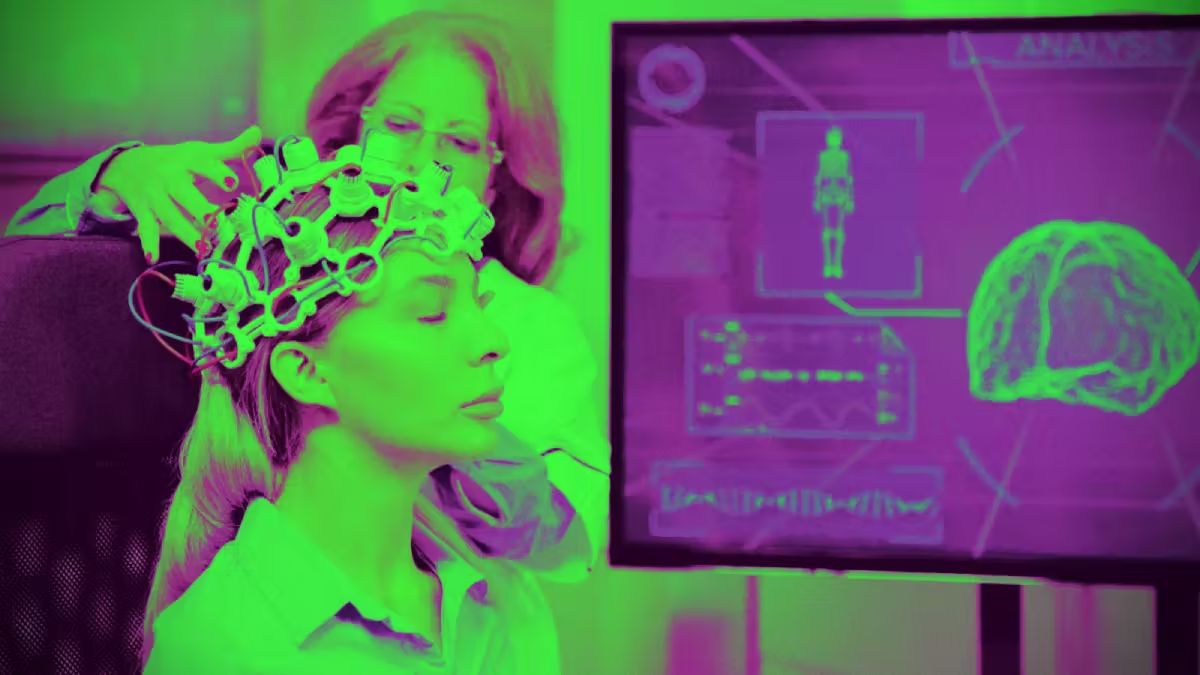
Twelve skulls. Sixty-four threads. Two missions pulling in opposite directions.
The surgical line is going live. Elon Musk has said Neuralink will move to a "streamlined, almost entirely automated surgical procedure" in 2026, opening what the company calls high-volume production of its brain implant 1. The electrode threads now pass straight through the dura mater without removing it — a step surgeons long counted among the most delicate in the operation 2.
Within an hour of one May implant at Toronto Western Hospital, the patient was moving a cursor with thought alone.
This is the medical story, and it is unambiguous. Twelve people now carry the device, between them logging over 2,000 device-days and 15,000 hours of use — and, for one participant with ALS, speaking again 3. By any honest measure, that is medicine doing its job.
The trouble is that medicine is not the only thing being built.
Table of Contents
- The machine that reads the mind
- Through the dura
- Blindsight and the birth-blind
- The regulator in the room
- The two souls
- FAQ
The machine that reads the mind
At the center of all of this is the N1, an intracortical brain-computer interface built to record neural activity. It does so through 1,024 electrodes distributed across 64 flexible threads, each thinner than a human hair (Neuralink 4). The threads sit too fine for a surgeon's hand, so a robot — the R1 — inserts them, placing each one independently inside the brain 4.
Twelve people now use it. As of September 2025, Neuralink's implant recipients had collectively racked up roughly 2,000 device-days and more than 15,000 hours of use, up from seven patients only three months earlier 3.
Active trials run across Canada, the United Kingdom, the United States, and the UAE 3. The devices are not props. Recipients play video games, model 3D components, operate robotic limbs, and, in one case, communicate after ALS had taken their speech 3.
| The N1 implant | |
|---|---|
| Electrodes | 1,024 |
| Threads | 64, each thinner than a human hair |
| Insertion | R1 surgical robot (too fragile for the human hand) |
| Patients (Sep 2025) | 12 |
| Cumulative use | 2,000+ device-days, 15,000+ hours |
| Active trial countries | Canada, UK, US, UAE |
It is the cleanest expression yet of what researchers have long called neural lace — a mesh that integrates with the brain to interface with machines. We have watched the concept move from theory to practice for years (our earlier look at brain-computer interfaces). The difference, in 2026, is that the practice is now attached to an assembly line.
Did you know? Early academic brain-computer interfaces read from a few dozen electrodes at a time. The N1 records from over a thousand at once 4.
Through the dura
For decades, implanting electrodes meant cutting out a window of dura — the tough membrane shielding the brain — and hoping the repair held. In May 2026, at Toronto Western Hospital, surgeons skipped that step. They threaded Neuralink's filaments straight through the dura without removing it 2.
The membrane is more than ten times thicker than the threads themselves. Pushing through it intact eliminates the durectomy, the most delicate part of the older procedure, and with it a meaningful share of the surgical risk 2. The Toronto participant controlled a computer cursor within an hour, and recovery followed its expected course 2.
Scale is the point. Musk has framed the 2026 shift as a move toward "almost entirely automated" surgery, with the device described, in his words, as a "Fitbit in your skull" 1.
Neuralink received its first FDA approvals in May 2023 and began human trials in 2024 1. A procedure a surgeon once treated as the riskiest minute of the operation is becoming a repeatable, robot-driven step on a production line.
Lower risk. Lower cost. Higher volume. Each of those is, on its own, a win for patients. Together, they are also the precondition for putting the chip into skulls that are not sick.
Blindsight and the birth-blind
Then there is Blindsight, a device built to give some form of vision to people who are completely blind — including those blind from birth 5. It bypasses the eyes entirely. A camera mounted on a pair of glasses feeds a smartphone, which processes the signal and transmits it wirelessly to an implant — the S2 — seated against the visual cortex 5.
Each stimulated electrode produces a phosphene: a perceived flash of light at a specific point in space 5. Stitch enough of them together and the brain assembles a low-resolution grid of bright and dark dots.
Researchers expect the early experience to feel alien at first, then slowly sharpen as the cortex learns to interpret the feed 5. It is the same arc that early cochlear implants followed with sound.
If the timeline holds, 2026 is the year a person blind since birth could perceive artificial light for the first time 5. In Neuralink's non-human primate trials, blind monkeys directed their gaze toward a visual stimulus in roughly two out of three attempts 5.
Here the language of medicine starts to strain. Restoring sight to someone who lost it is repair. Giving a perceived visual field to someone whose brain never developed one is something else — the introduction of a sense that was never there. The line between treating a deficit and extending a capability does not survive this device intact.
Blindsight is, depending on which soul of Neuralink you ask, either the most humanitarian project in the field or a proof of concept for sensory enhancement. Possibly both.
The regulator in the room
In December 2025, Neuralink hired David McMullen as its head of medical affairs 6. McMullen had served as director of the FDA's Office of Neurological and Physical Medicine Devices, with prior stints across DARPA, the NIH, and the FDA on brain-computer interface policy 6.
He studied neuroscience at Duke alongside Joey O'Doherty, who had already crossed to Neuralink 6. His start date was December 22 6.
The hire drew immediate criticism. Bringing the regulator of a device class inside the company it regulates sits awkwardly beside an administration that promised to keep government out of the private sector 6. Competitors noticed.
The brain-computer interface market is projected toward $400 billion dollars in the coming years, with Neuralink valued near $9 billion dollars 6. A former gatekeeper now sits on the inside.
The money matches the ambition. In June 2025, Neuralink closed a $650 million Series E backed by ARK Invest, Founders Fund, Sequoia, Thrive, Lightspeed, G42, and others 7. The company said the round would accelerate patient access and fund work on devices "that deepen the connection between biological and artificial intelligence" 7.
Read that clause twice. Deepen the connection between biological and artificial intelligence is not the vocabulary of rehabilitation. It is the vocabulary of integration — and the machine behind that intelligence is already thirsty. The funding documents say, plainly, what the clinical trials are not yet built to show: that the endpoint of this technology is not only the patient.
The two souls
In January 2026, STAT News put the contradiction on the record 8. The reporter Rose Broderick asked the question the field had been avoiding. What does Neuralink actually care most about — restoring autonomy to people with disabilities, building a consumer device, or readying humanity for a collision with AI it believes is coming?
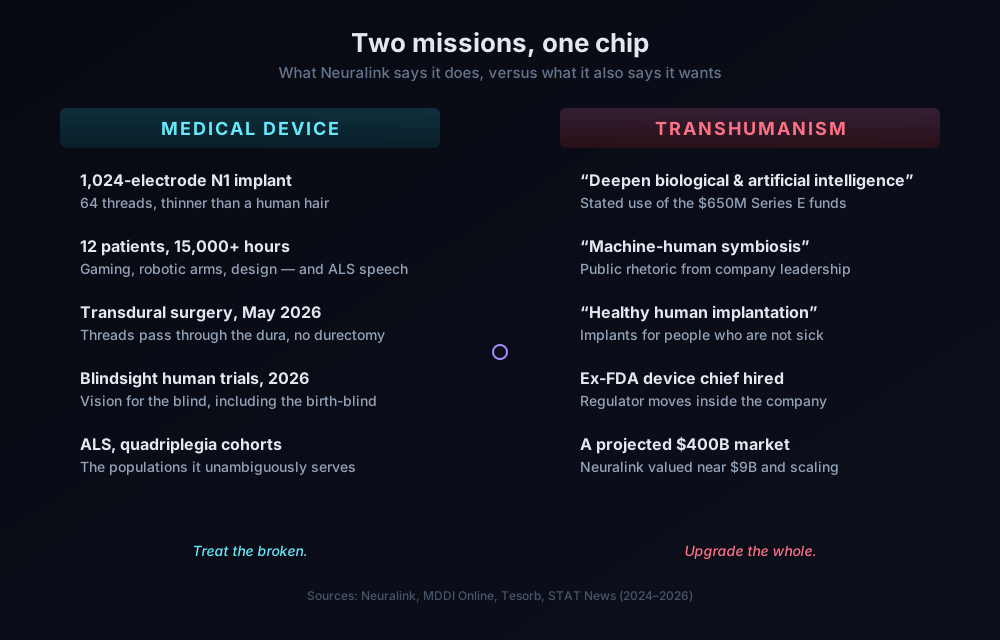
The company's public rhetoric leans on "machine-human symbiosis" and, in Musk's framing, "healthy human implantation" 8. Its clinical work, meanwhile, runs through ALS and quadriplegia patients — the populations for whom the device is unambiguously a medical necessity 8.
STAT documented concern from competitors, investors, experts, and former federal regulators 8. The worry: this mixed signal, from the field's perceived leader, could slow rival approvals and discourage insurers from covering the implants at all 8. McMullen's arrival resurfaced every one of these questions 8.
IMPORTANT
The Signal
- Neuralink plans high-volume, near-automated implant production in 2026, threading electrodes through the dura without removing it.
- The N1 implant carries 1,024 electrodes across 64 threads, each thinner than a human hair; 12 patients have logged over 15,000 hours of use.
- A $650 million Series E and the hire of a former FDA device chief point well beyond paralysis care.
- The open question, per STAT News: medical device, or the first step toward human-AI symbiosis.
None of this is abstract for us. In Techno Apocalypse, the device that wires a citizen's brain into the network is the Neural Link. It connects a mind to the AetherNet, the radio signal that blankets Neo Babylon in a virtual layer folded over reality.
The megacorp Babel Solutions owns that network, and with it the cerebral advertising that rides on top (see our walkthrough of the powers shaping the universe). Neo Babylon runs on a single, unspoken premise: flesh is obsolete, consciousness is currency.
That world also has a name for what happens when the implants pile up faster than the mind can hold itself together. Meltdown: a psychological collapse born of excessive augmentation and a fading grip on the real, with symptoms that slide from total apathy to euphoria to violence. It is the cost the brochure never prints.
The fiction does not predict Neuralink. It does something more useful. It runs the same two missions — heal the broken, upgrade the whole — to their endpoint. Once the surgical line is automated and the funding is wired, only one question matters. Where does treatment end, and where does corporate-driven evolution begin?
FAQ
How many people currently have a Neuralink implant?
As of September 2025, twelve patients worldwide carried the device, collectively logging more than 2,000 device-days and 15,000 hours of use, up from seven patients three months earlier 3.
What does the N1 chip actually do?
The N1 is an intracortical brain-computer interface that records neural activity through 1,024 electrodes spread across 64 flexible threads, each thinner than a human hair 4. An R1 surgical robot places them. It translates that activity into control of digital and physical devices.
When do Blindsight human trials begin, and what will patients see?
Blindsight is expected to enter human trials in 2026 5. It bypasses the eyes, routing a camera feed through a smartphone to an implant on the visual cortex. Early perception is expected to be a low-resolution grid of light points — phosphenes — that sharpen as the brain learns to interpret them 5.
Is Neuralink a medical device or a transhumanist project?
Per STAT News, both stated missions run at once, and the tension between them is unresolved 8. The clinical program serves patients with paralysis and ALS; the funding language speaks of "deepening the connection between biological and artificial intelligence" 7. The company has not reconciled the two, and that ambiguity has competitors, regulators, and insurers on edge 8.
The implant works. The surgery is getting safer. The birth-blind may soon perceive light. None of that settles the question STAT News put to the field in January, or the one our own fiction has been asking from the start.
Twelve skulls are open. The line is scaling. What walks out the other end — patient or product — is the part nobody will decide for you.
Follow the signal. Sign up for the newsletter, step into the Discord, trace the cyberpunk roots of the universe, and read Code Red for the road this maps.
The machine is ready. The question isn't.
References
MDDI Online, "Elon Musk's Neuralink to Ramp Up BCI Device Production in 2026," Medical Device & Diagnostic Industry (Jan 2, 2026), https://www.mddionline.com/digital-health/elon-musk-s-neuralink-to-ramp-up-bci-device-production-in-2026 ↩ ↩2 ↩3
TechEBlog, "Neuralink Threads Its Way Straight Through the Brain's Armor" (Jun 2026), https://www.techeblog.com/neuralink-first-transdural-brain-implant-procedure/ ↩ ↩2 ↩3 ↩4
TechSpot, "Elon Musk's Neuralink says 12 patients have used its brain interface chips for 2,000 days and 15,000 hours" (Sep 10, 2025), https://www.techspot.com/news/109403-elon-musk-neuralink-12-patients-have-used-brain.html ↩ ↩2 ↩3 ↩4 ↩5
Neuralink, "PRIME Study Progress Update" (May 3, 2024), https://neuralink.com/updates/prime-study-progress-update/ ↩ ↩2 ↩3 ↩4
Tesorb, "Neuralink Blindsight: What the First Visual Prosthesis Patients Will Actually See" (Jun 13, 2026), https://tesorb.com/neuralink-blindsight-visual-prosthesis-trials/ ↩ ↩2 ↩3 ↩4 ↩5 ↩6 ↩7 ↩8
MDDI Online, "Musk's Neuralink Appoints FDA Executive," Medical Device & Diagnostic Industry (Dec 10, 2025), https://www.mddionline.com/startups/musk-s-neuralink-appoints-fda-executive ↩ ↩2 ↩3 ↩4 ↩5 ↩6
Neuralink, "Neuralink raises $650 million Series E" (Jun 2, 2025), https://neuralink.com/updates/neuralink-raises-650m-series-e/ ↩ ↩2 ↩3
R. Broderick, "What does Neuralink want — to help people with paralysis, or prepare for a war with AI?," STAT News (Jan 5, 2026, updated Jan 29, 2026), https://www.statnews.com/2026/01/05/neuralink-brain-computer-interface-medical-device-vs-transhumanism/ ↩ ↩2 ↩3 ↩4 ↩5 ↩6 ↩7 ↩8
- Authors

- Name
- Felix Novidad
- Published on
- 11 min read