The Algorithm Pulls the Trigger
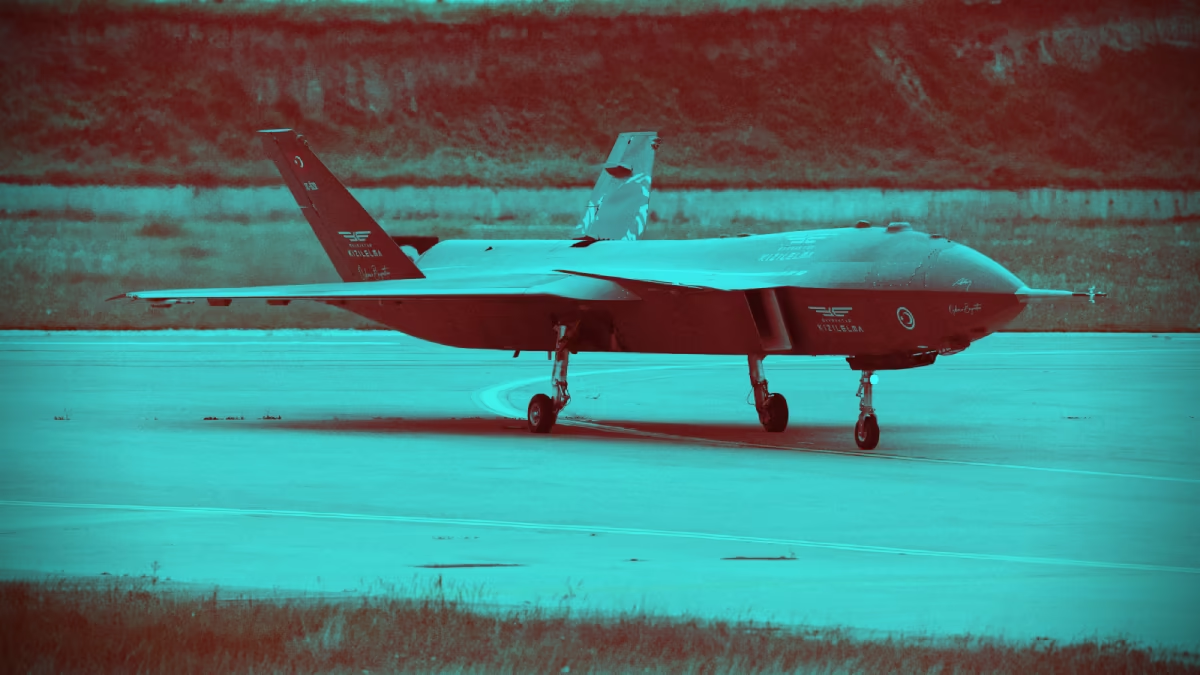
The last human component on the front line is the trigger finger.
A carbon frame, a camera, an onboard model. For roughly $25 — about 1,000 hryvnia — a first-person-view drone stops needing its pilot in the final seconds of flight 1. The operator designates the target. The machine closes the distance.
This is not a laboratory demonstrator. It is the workhorse of the war in Ukraine: produced by the hundred thousand, lost by the thousand each month, and improved with every combat hour it records 2. The same equation — cheap airframe, cheap sensor, expensive intelligence — is now redrawing procurement tables in Washington 3.
IMPORTANT
- Drones cause an estimated 70–80% of battlefield casualties in the Russia–Ukraine war 1.
- AI terminal guidance lifts FPV strike accuracy from 30–50% to roughly 80%, with add-on hardware priced around $25 per drone 2 1.
- In March 2026 the U.S. Army consolidated an estimated 120–130 orders into an Anduril umbrella agreement with a ceiling of up to $20 billion dollars; Palantir's separate Army vehicle is worth up to $10 billion over ten years 3 4.
- Ukraine has become the first country to open real battlefield data to allied AI models 5.
The Front Line Already Runs on Autonomy
Both sides went to war with remote-controlled drones. Then electronic warfare made remote control impossible: Russian jammers overpower the video link, and a drone that loses its signal drifts, aborts, or crashes 2.
The answer was to remove the link. Current FPV drones carry computer-vision models that lock onto a target and guide the strike on their own 2. This is terminal guidance — the last mile of the kill chain, with no radio left to jam. The pilot chooses the target. The algorithm pulls the trigger.
The accuracy figures explain the scramble. Piloted FPV strikes connect at 30–50%; novices manage closer to 10%. Onboard AI models lift the rate to roughly 80% 2 1.

Swarming pushes the pilot further out of the loop. Ukrainian long-range strikes have used swarms of up to 20 drones, with decoys and air-defense hunters flying ahead of the strikers. Ukrainian firm Swarmer builds software that coordinates hundreds of airframes at once — "far beyond the capacity of human pilots," as one field account puts it 2.
The scale is industrial. Russia produced roughly 1.4 million drones in 2024, a near tenfold increase. Ukraine, by the Royal United Services Institute's estimate, was losing about 10,000 drones a month at the height of 2023 2. At Chasiv Yar, medics reported that up to 90% of wounded Ukrainian soldiers had been hit by FPV strikes or drone-dropped munitions 2.
Attrition that once required an air force now runs on commodity airframes and sensors. Kyiv is testing more than 70 types of unmanned ground vehicle and aims to clear a 15-kilometre unmanned zone along the entire front 1. What does a pilot still contribute when the aircraft no longer needs one?
Combat Data Is the New Ammunition
Autonomy is trained, not programmed. Models need footage — tanks in motion, infantry behaviour, terrain, season, light — and the side that collects more of it learns faster 2.
Ukraine's OCHI system has archived roughly two million hours of battlefield video since 2022, the work of more than 15,000 drone crews. That is about 228 years of continuous combat footage 1.
Did you know? Two million hours of drone footage is not a backlog. It is a strategic reserve — and few NATO air forces own anything comparable, because none has fought this way.
In March 2026, Kyiv made that reserve a matter of alliance. Ukraine's defence ministry opened access to its battlefield data so partner states and companies can train drone AI on real combat records. It is the first country in the world to do so. The platform lets allies feed their models without touching Ukraine's other military databases 5.
The machine's appetite for combat records mirrors its appetite for power and water, and both bills land on the same desk (The Thirst of the Machine). Munitions can be stockpiled; a corpus of real war cannot. When the ammunition is data, what exactly does a neutral country stay out of?
The New Merchants of War
Washington is not watching from the sidelines. In March 2026 the U.S. Army folded an estimated 120–130 separate orders into a single umbrella agreement with Anduril Industries 3. The ceiling reaches up to $20 billion over five to ten years, covering counter-drone hardware, software, and services, with an initial task order of $87 million.
Palantir had already set the template: a ten-year Army vehicle worth up to $10 billion, signed in 2025. Its U.S. government revenue reached $426 million in a single quarter, up 53% year over year 4. That is 42% of everything it sells, and the company raised its annual forecast to $4.14–4.15 billion.
| Contractor | Vehicle | Ceiling | Duration | Focus |
|---|---|---|---|---|
| Anduril | Army umbrella agreement | up to $20B | 5–10 yrs | Counter-drone systems |
| Palantir | Army research vehicle | up to $10B | 10 yrs | AI data platforms |
The contract structure is the louder signal. Both deals are firm-fixed-price: the government locks the cost, industry absorbs the overruns.
"That's the goal, to take the risk out of the government's hands and into industry."
— Anduril president Matthew Steckman told Fortune 3.
Fixed-price has teeth — Boeing absorbed more than $7 billion in losses on the KC-46 tanker under the same structure 3. The merchant class changes; the risk does not disappear — it just changes owner.
Georgetown's Center for Security and Emerging Technology has traced this budget shift since 2020, flagging knowledge gaps in human-machine teaming and pressing for investment in trustworthy, reliable, and secure AI 6. The money moved faster than the doctrine. It usually does.
The Ledger and the Ledge
The benefit column is easy to write. A $25 targeting module that converts a 30–50% hit rate into roughly 80% may be the cheapest lethality upgrade in the history of air power 2 1. Attrition becomes arithmetic: drones lost by the thousand each month are replaced by the million each year.
One 150-strong Ukrainian drone unit reported killing or wounding 1,500 Russian soldiers in six months while taking minimal casualties of its own 2.

The risk column is longer. RAND Corporation analysts warned in 2020 that autonomous weapons deliver real operational advantages. In the same stroke, they compress the time between detection and destruction past the pace of human diplomacy. Crisis stability — the margin that lets a standoff cool — is what gets spent 7.
The targeting list is where the risk shows first. U.S. Army War College scholars cite Israel's Lavender system, which reportedly nominated up to 37,000 Palestinians as militant-linked targets for human review 1. Machine-generated nominations at a scale no reviewing staff had ever faced. Austrian foreign minister Alexander Schallenberg called the trend the "Oppenheimer moment" of this generation 1.
The pilots draw their own line. Ukrainian drone operators insist humans stay in every life-or-death decision — a constraint volunteered by the only military that has actually fought at this tempo 1. Stability was built on humans being slow. What is it built on now?
Neo Babylon Already Fought This War
Readers of Techno Apocalypse know where the curve ends. The chronicle of Neo Babylon files two of its corporate wars — CW3 and CW4 — under one name: the AI wars. How they were fought, and what they were fought over, waits in the books.
ArexCorp: war as a product line
ArexCorp — Neo Babylon's military-sector power, specialist in weapons and neural warfare — supplies the Disunited States of America. Its catalogue is a modern procurement spreadsheet pushed one generation forward: neural-linked combat exoskeletons, autonomous defense systems, memory-altering suppression technology, synthetic combat organisms (Corporate Titans: The Powers Shaping the Transhuman Dream Universe).
"Peace was never profitable. The new world order demands a new kind of security, one that Arexcorp alone can provide. Those who fear the future will always pay handsomely for protection."
— Jason Cavendish, CEO of ArexCorp
Every line item has a 2026 ancestor. Brain-computer interfaces are already in human trials (The Two Souls of Neuralink); autonomous interceptors already have a $20 billion procurement lane 3; only the memory tech still waits in the laboratory.
Did you know? More than 60% of ArexCorp's executive board are decorated war veterans — a higher concentration of former military personnel than any other corporation in Neo Babylon.
ExoCo: the warning
ExoCo funded the research no one else would touch: Omega-generation AI, autonomous systems with self-evolutionary capabilities, and consciousness transfer between humans and artificial constructs. The corporation did not survive the AI wars that followed (Corporate Titans).
The lived mirror is uncomfortable. Ukraine is feeding two million hours of real combat into allied AI models so those models improve from their own operations 1 5. Systems that learn from their own behaviour are now the explicit product requirement. For the consciousness-transfer lineage, see Mind Uploading and Digital Immortality.
The corporation is gone. The research questions are not. Who carries them when the corporation is a country?
CW4 is filed in Neo Babylon under fiction. The hardware that could re-file it is on this year's invoices. The algorithm already pulls the trigger; the only question left open is who writes the target list. Follow the front line — dispatches via newsletter, arguments via Discord.
FAQ
How is AI actually used on the battlefield in Ukraine?
Terminal guidance is the core application: computer-vision models lock onto targets and guide FPV drones through jamming that breaks remote control, lifting strike accuracy from 30–50% to roughly 80%. Swarming coordination and unmanned ground vehicles follow, with over 70 UGV types tested and a planned 15-kilometre unmanned front line 2 1.
Which companies are investing in military AI?
Anduril holds a U.S. Army umbrella agreement with a ceiling of up to $20 billion over five to ten years, focused on counter-drone systems. Palantir's ten-year Army vehicle is worth up to $10 billion, and its U.S. government revenue grew 53% year over year 3 4. Traditional primes such as Lockheed Martin and Boeing remain larger, but they no longer set the tempo 3.
How much does AI targeting cost?
Around $25 per drone for a targeting add-on, according to Ukrainian commanders — roughly 1,000 hryvnia. More extensive AI modifications run $100–200 per airframe. The module does the work of a trained pilot in the final seconds of flight 2 1.
Can these weapons fire without a human decision?
Terminal guidance already executes the final strike autonomously once a human designates the target. Full machine-selected targeting has been approached — Israel's Lavender system reportedly nominated up to 37,000 targets for human review — and Ukrainian pilots insist humans remain in every life-or-death decision 2 1.
References
David Kirichenko, "AI's Growing Role in Modern Warfare," War Room, U.S. Army War College (2025), https://warroom.armywarcollege.edu/articles/ais-growing-role/ ↩ ↩2 ↩3 ↩4 ↩5 ↩6 ↩7 ↩8 ↩9 ↩10 ↩11 ↩12 ↩13 ↩14
"The Rush for AI-Enabled Drones on Ukrainian Battlefields," Lawfare Media (retrieved August 20, 2026), https://www.lawfaremedia.org/article/the-rush-for-ai-enabled-drones-on-ukrainian-battlefields ↩ ↩2 ↩3 ↩4 ↩5 ↩6 ↩7 ↩8 ↩9 ↩10 ↩11 ↩12 ↩13 ↩14
"Anduril's new mega-deal rewrites the rules for Silicon Valley—and raises new risks," Fortune (2026), https://fortune.com/2026/03/22/anduril-pentagon-contract-turning-point/ ↩ ↩2 ↩3 ↩4 ↩5 ↩6 ↩7 ↩8
"Palantir raises annual revenue forecast again," Reuters via Yahoo Finance (2025), https://finance.yahoo.com/news/palantir-raises-annual-revenue-forecast-200910458.html ↩ ↩2 ↩3
"Ukraine opens battlefield data access to allies' AI models," Reuters (2026), https://www.reuters.com/business/aerospace-defense/ukraine-opens-battlefield-data-access-allies-ai-models-2026-03-12/ ↩ ↩2 ↩3
Margarita Konaev, Husanjot Chahal, Ryan Fedasiuk, Tina Huang, and Ilya Rahkovsky, "U.S. Military Investments in Autonomy and AI: Costs, Benefits, and Strategic Effects," Center for Security and Emerging Technology, Georgetown University (2020), https://cset.georgetown.edu/publication/u-s-military-investments-in-autonomy-and-ai-costs-benefits-and-strategic-effects/ ↩
"The Risks of Autonomous Weapons Systems for Crisis Stability and Conflict Escalation," RAND Corporation (2020), https://www.rand.org/pubs/commentary/2020/06/the-risks-of-autonomous-weapons-systems-for-crisis.html ↩
- Authors

- Name
- Felix Novidad
- Published on
- 11 min read